




Dental Implants – Get Your Teeth Immediately, Without Disrupting Your Life
One of the biggest concerns for patients considering dental implants is not necessarily the implant placement itself, but: “After getting...
 Published: 04/11/2025
Dental Knowledge
Published: 04/11/2025
Dental Knowledge
When the dental pulp becomes inflamed, infected, or necrotic, root canal treatment (endodontic therapy) is one of the most important solutions to remove damaged pulp tissue, control infection, and preserve the natural tooth. This is a necessary treatment in many cases to relieve pain, prevent complications, and maintain the tooth’s chewing function over the long term.
The dental pulp is the soft tissue inside the tooth that contains blood vessels and nerves. When bacteria penetrate deep into the tooth due to decay, cracks, fractures, or trauma, the pulp tissue can become inflamed, infected, or irreversibly damaged. If not treated at the right time, the condition may progress further, affect the tissues around the root tip, and increase the risk of tooth loss.
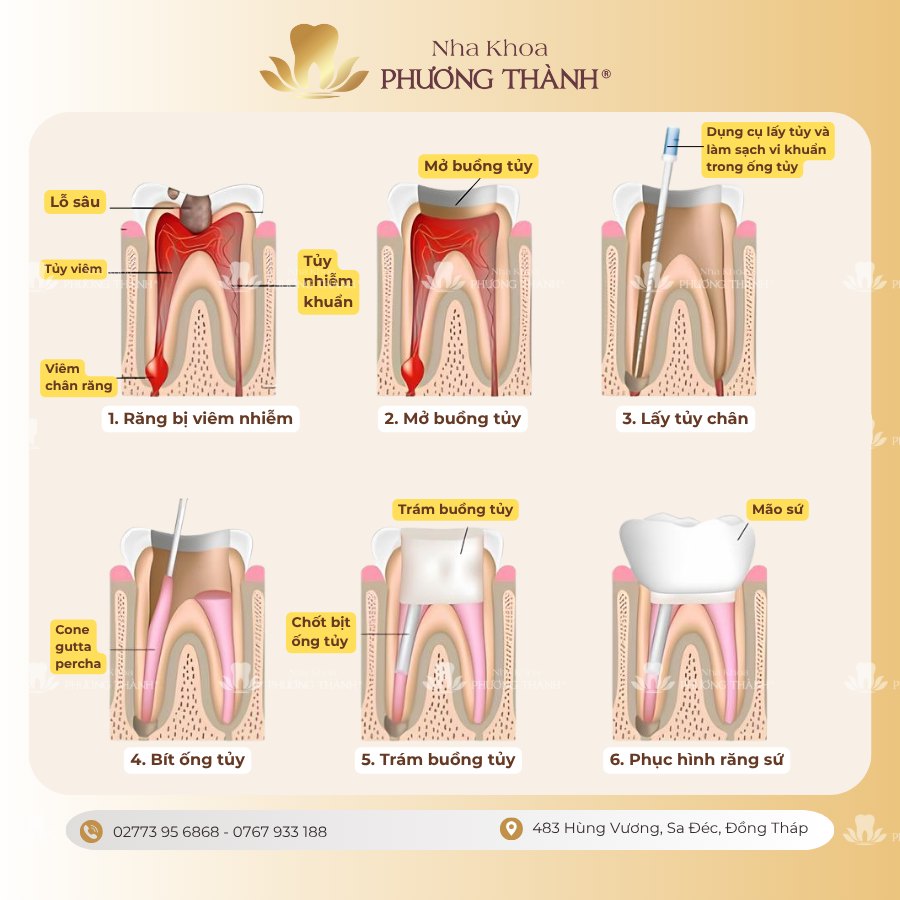
Below are the standard steps of root canal treatment at Phuong Thanh Dental Clinic:
1. Tooth affected by pulp inflammation
Pulp inflammation often begins when bacteria enter the inside of the tooth through damage such as cavities, cracked teeth, chipped teeth, or long-standing deep decay. Patients may experience symptoms such as dull or severe pain, prolonged sensitivity, worsening pain at night, gum swelling, or discomfort while chewing. In some cases, untreated pulp inflammation may also lead to periapical inflammation if not managed early.
2. Access opening to the pulp chamber
After examination and confirmation of the treatment indication, the dentist will create a small opening on the crown of the tooth to access the pulp chamber. This is an important step that allows the removal of inflamed or infected pulp tissue and provides better access for precise treatment of the root canal system inside the tooth.
3. Cleaning and shaping the root canal system
Next, the dentist will clean the root canal system using endodontic equipment and specialized rotary files. This process helps remove damaged pulp tissue, bacteria, and remaining inflamed tissue from inside the canals. Thorough cleaning plays a crucial role, as it directly affects the effectiveness and long-term success of the treatment.
4. Root canal filling
Once the root canal system has been properly cleaned and treated, the dentist will fill and seal the canals using specialized materials. The purpose of this step is to close the internal space within the root canals, reduce the risk of bacterial reinfection, and help protect the remaining root structure.
5. Restoration of the tooth crown
After root canal treatment, the crown of the tooth will be restored with an appropriate filling material to recreate its original shape, maintain aesthetics, and support chewing function. This is a necessary step to help the tooth continue functioning properly after endodontic treatment.
6. Ceramic restoration when necessary
In cases where the tooth has lost a large amount of structure, has thin and weakened walls, or is at risk of fracture after treatment, the dentist may recommend restoration with a ceramic crown or an endocrown. This option helps improve the strength of the tooth, protect the remaining structure, and enhance long-term durability.
Early root canal treatment increases the chance of preserving the natural tooth and helps limit more complex complications in the future. When pulp inflammation is left untreated for too long, the tooth may face risks such as spreading infection, periapical abscess, bone loss around the root tip, prolonged pain, or more severe tooth structure damage. In advanced cases, saving the natural tooth can become much more difficult.
That is why early detection and timely treatment not only help relieve pain effectively, but also contribute to preserving the natural tooth for a much longer time.

At Phuong Thanh Dental Clinic, root canal treatment is supported by an endodontic microscope, which helps the dentist observe the complex internal structure of the root canal system more clearly. This is especially beneficial in cases involving small, curved, narrow, branched, or difficult-to-access canals that may not be easily visible through standard observation.
The use of a microscope in endodontic treatment helps improve precision in every step, supports more effective cleaning, and optimizes the ability to preserve the natural tooth. It is also one of the important factors that enhances treatment quality in complex root canal cases.
Root canal treatment is not only a solution to relieve pain caused by pulp inflammation, but also an important step in preserving the natural tooth and reducing the risk of tooth loss when performed at the right time.
One of the biggest concerns for patients considering dental implants is not necessarily the implant placement itself, but: “After getting...

Dental Floss – A Small Tool with a Big Role in Oral Care Dental floss is one of the oral...

Parents should not overlook common oral health problems in children such as tooth decay, gingivitis, pulpitis, and tongue-tie. Early detection...
What Are Exogenous Chromogenic Stains on Teeth? Images of Exogenous Chromogenic Stains on Teeth Exogenous chromogenic stains on teeth are...
WORKING HOURS