
Dental Implants – Get Your Teeth Immediately, Without Disrupting Your Life
One of the biggest concerns for patients considering dental implants is not necessarily the implant placement itself, but: “After getting...
 Published: 05/05/2026
Dental Knowledge
Published: 05/05/2026
Dental Knowledge
When you experience dry mouth, difficulty swallowing, or loss of appetite, it is not merely a temporary sensation. It is a sign that the body is lacking an important factor: saliva. Few people realize that the body secretes approximately 500–700 ml of saliva every day, a biological fluid that may seem simple yet participates in most functions ranging from eating, protecting teeth, to digestion and immunity.
Scientifically, saliva consists of up to 99% water, but the remaining 1% is what truly “makes the difference.”
It contains:
This combination makes saliva not merely a moistening substance, but a continuously functioning biological system.
After eating, bacteria in the mouth metabolize sugar into acid.
This acid lowers the pH below 5.5 – the threshold at which tooth enamel begins to dissolve.
Saliva intervenes through 3 mechanisms:
 |
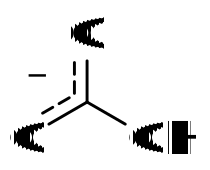 |
Saliva contains bicarbonate – a substance capable of “buffering pH.”
Mechanism:
When saliva flow increases (for example, during chewing), this buffering capacity becomes significantly stronger.
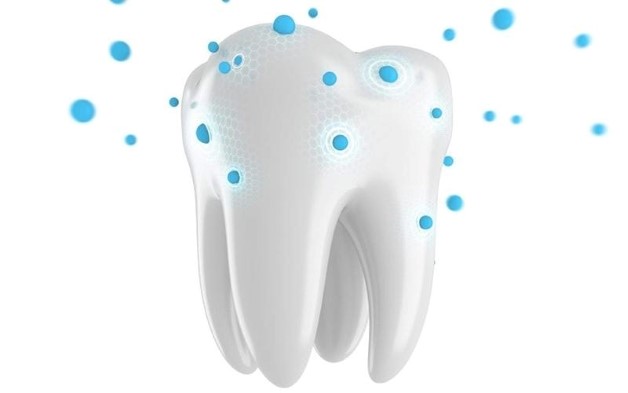
Tooth enamel is not a “dead” structure.
It is constantly in a state of balance:
Saliva contains calcium and phosphate in a “supersaturated” state.
When the environment stabilizes, these ions redeposit onto the enamel surface.
Simply put:
Saliva helps teeth “repair” tiny daily damages on their own.
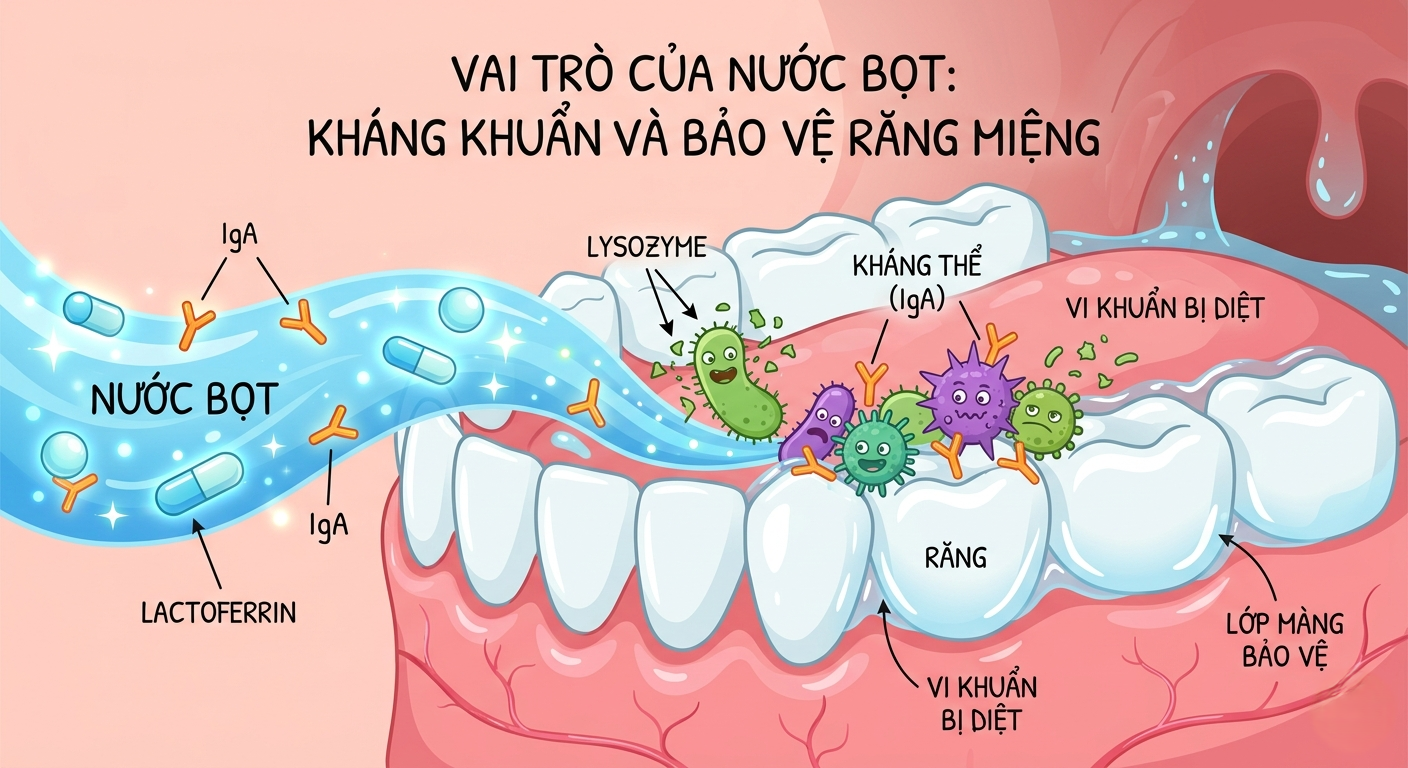
Saliva contains many substances capable of destroying bacteria:
This is a form of local immunity that works continuously without conscious effort.
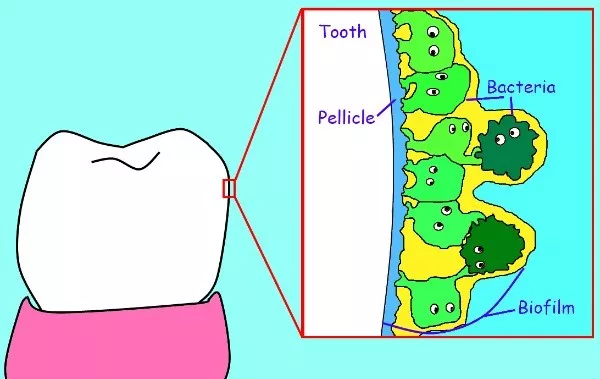
Immediately after teeth are cleaned, saliva forms a very thin protein layer called the pellicle.
Essentially:
Research shows that this layer can significantly reduce the rate of mineral loss when exposed to acid.
In other words:
Before you even do anything, saliva has already created an “armor layer” for your teeth.
Saliva does not stop at the oral cavity.
When swallowed, it continues to:
In particular, bicarbonate in saliva helps reduce acid-related damage to the esophagus – a factor associated with gastroesophageal reflux disease.
When saliva flow decreases (below 0.2 ml/minute):
Additionally:
This is not merely an oral health issue, but a physiological functional disorder.
One remarkable point in modern medicine:
Saliva can reflect the body’s condition because many substances within it originate from the bloodstream:
Thanks to molecular biology techniques, saliva is becoming a simple, cost-effective diagnostic tool that does not require blood sampling.
Saliva is not merely an “accessory” part of the body.
It is:
Silently, it works continuously.
And only when it is lacking do people realize:
every seemingly simple function inside the mouth depends on it.
Sa Dec Headquarters: 483 Hung Vuong Street, Cai Son Hamlet, Sa Dec Ward, Dong Thap Province.
Hotline: 02773 95 6868
Cao Lanh Headquarters: 783 Pham Huu Lau Street, Cao Lanh Ward, Dong Thap Province (Inside Dong Thap University Campus)
Hotline: 02773 95 6869
P.T.T
One of the biggest concerns for patients considering dental implants is not necessarily the implant placement itself, but: “After getting...
Dental Floss – A Small Tool with a Big Role in Oral Care Dental floss is one of the oral...

Parents should not overlook common oral health problems in children such as tooth decay, gingivitis, pulpitis, and tongue-tie. Early detection...
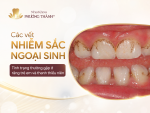
What Are Exogenous Chromogenic Stains on Teeth? Images of Exogenous Chromogenic Stains on Teeth Exogenous chromogenic stains on teeth are...
WORKING HOURS